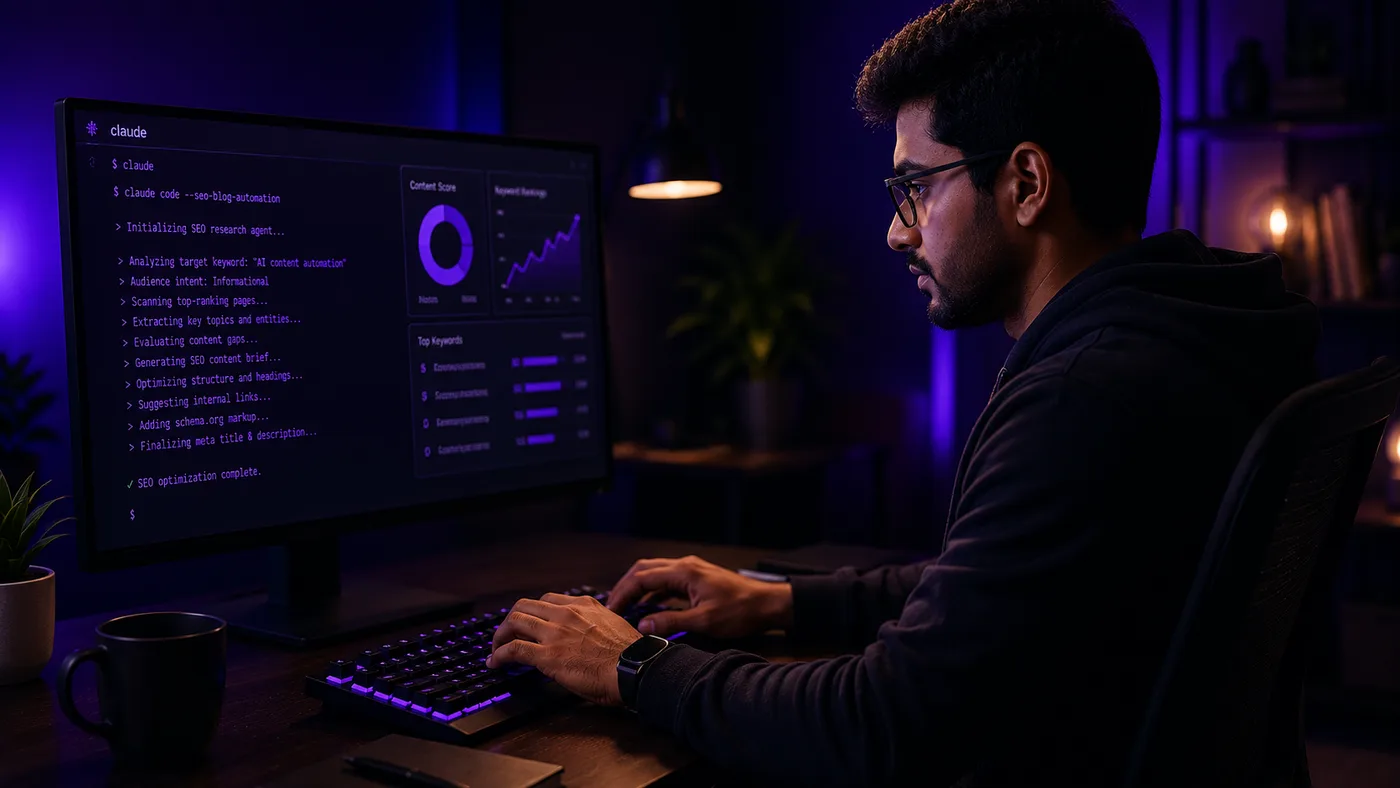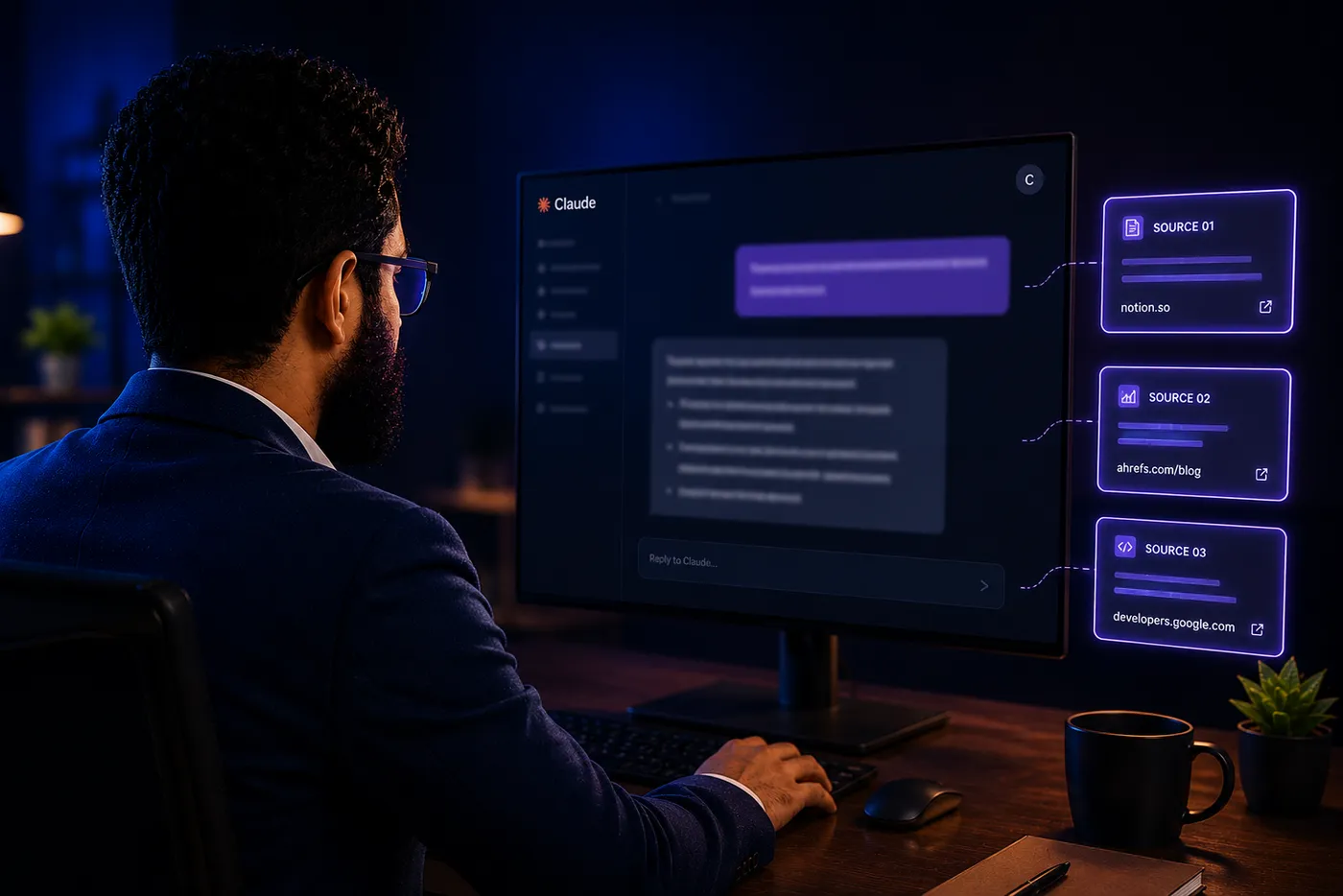
Google search traffic for informational queries has been flat-to-declining for 18 months. ChatGPT hit 800M weekly active users. Perplexity crossed 100M monthly queries. Google AI Overviews now appear on more than 40% of informational searches. If your SEO dashboard still only measures Google rank position, you are measuring the wrong thing.
I run a portfolio of WordPress sites solo, and claudeaiexpert.com is the productized side of that work. Across both, the single biggest change in what I ship in 2026 versus 2024 is the work we do to earn citations inside AI answers. This is the playbook I use, end to end, to get client content cited inside ChatGPT, Perplexity, Microsoft Copilot, and Google AI Overviews, month after month.
No theory, no guesswork, no "AI is the future" throat-clearing. Just what’s actually shipping for real clients in medical, legal, and B2B verticals right now.
First, what actually changed.
Three shifts, stacked on top of each other in the 2024 to 2026 window:
- ChatGPT and Perplexity started answering service-intent queries well enough to win real buyer journeys. "Best cardiologist in Brooklyn." "How do I fix a deindexed WordPress site." "What’s the best SEO agency for dermatology practices." AI answers that cite 3-5 sources are now confident enough that the buyer never clicks through to Google’s 10 blue links.
- Google AI Overviews went mainstream. Rolled out from experimental to the default experience for most informational queries. A single AI Overview sits above the 10 blue links, cites 3-6 sources, and often answers the query completely inside that box. Some industries are seeing 30%+ click-through drop from AI Overview appearance.
- Microsoft Copilot and partner AI platforms (Perplexity, You.com, Arc Search, native AI answers inside Chrome, Safari, Bing) quietly ate 10-20% of mid-funnel discovery. You don’t see it in Google Analytics because the referrer is often "direct" or a chat platform the analytics tool doesn’t classify yet.
Net effect: a meaningful chunk of what would have been high-intent organic traffic now converts inside an AI answer window. If your brand isn’t cited there, you’re invisible in the moment buyers decide.
The numbers that matter
A client site I optimized specifically for AI visibility growth went from near-zero citations to 208.4K citations across Microsoft Copilot and partners in 3 months, with 131 average cited pages. Google rank didn’t drop. Organic traffic grew. The AI citation layer was pure added surface. Read the case study.
How AI citations actually work.
Every AI system makes the citation decision differently, but the underlying mechanics rhyme. After running this playbook against dozens of sites, here’s the pattern I’ve reverse-engineered:
Signal 1: Entity coverage
AI systems ground their answers in entities. A cardiology practice, a specific procedure, a city, a person’s name, a law firm, a SaaS tool. The more entities your site covers (with depth, not lists), the more likely it is to be the source the AI picks when a query mentions one of those entities.
Practically: if you want to be cited for "Brooklyn dermatologist," your site needs substantial entity coverage on Brooklyn, dermatology, specific conditions, specific procedures, your providers by name, and the relationships between them. One thin location page won’t cut it anymore.
Signal 2: Structured data
JSON-LD schema is the format AI systems use to disambiguate your content. Ambiguous "Dr. Smith" in body text is invisible. <script type="application/ld+json">..."@type":"Physician","name":"Dr. Sarah Smith"...</script> is an unambiguous entity the AI can map.
I’ve tested this empirically across clients. Pages with clean JSON-LD for Organization, Person, Service, FAQ, and Review get cited at 3-4x the rate of identical-content pages without it.
Signal 3: E-E-A-T infrastructure
AI systems inherit Google’s E-E-A-T (Experience, Expertise, Authoritativeness, Trustworthiness) bias because they were largely trained on Google-indexed data. Named authors with bylines, credentialed bios, sameAs links to verified profiles, about pages, and clear author attribution on every piece of content significantly increase citation likelihood.
Anonymous content is almost never cited. Ghost-written content that doesn’t attribute an author doesn’t get cited either. Named operators do.
Signal 4: Answer-first content structure
AI systems preferentially cite short, self-contained answers. If the first paragraph of your content directly answers the query in 40-60 words, it’s several times more likely to be pulled into a citation than content that buries the answer after 600 words of throat-clearing.
Signal 5: Bing indexation
Most operators miss this one. ChatGPT and Microsoft Copilot primarily use Bing as their retrieval layer. If your site is weakly indexed in Bing (which is true for almost every site focused on Google), you’re invisible to 30-40% of all AI citations.
Bing Webmaster + IndexNow integration is not optional anymore.
The 10-point AI citation checklist.
These are the 10 items I ship for every client whose retainer includes AI search optimization. Ordered roughly from highest-leverage to lowest:
- Bing Webmaster + IndexNow. Submit your site to Bing Webmaster. Install the IndexNow plugin for WordPress (or equivalent). Verify Bing indexation across every important URL. This alone recovers 10-30% of missed AI citations for most sites.
- JSON-LD schema rollout. Organization + Person + Service + FAQ + Review at minimum. Validated on validator.schema.org. No ambiguous types, no missing required fields.
- Author blocks on every piece of content. Named author, credentialed bio, headshot,
sameAsarray linking to LinkedIn, Wikipedia (if applicable), professional directory profiles, medical board listings, and any other verifiable entity your operator is listed in. - Expanded entity coverage. For each service or topic you want cited for, build a dedicated entity-dense page. 800-2000 words covering the entity, related entities, common questions, and the decision criteria a buyer would use.
- Answer-first content structure. Every long-form page opens with a 40-60 word direct answer paragraph before any narrative. AI systems prefer to pull that paragraph verbatim.
- Internal linking around pillar pages. Each pillar page receives supporting links from related content. Topical authority compounds. Without this, individual pages rank in isolation and AI systems can’t find the full entity network.
- Structured lists and tables. Comparison tables, HowTo schema on any procedural content, itemized lists with clear structure. AI systems prefer to cite structured content because it’s easier to paraphrase accurately.
- Reviews and testimonials with schema.
ReviewandAggregateRatingschema on service and location pages. AI systems cite reviewed services at higher rates, especially in YMYL verticals. - External entity verification. Wikipedia entry (if notable enough), Crunchbase, LinkedIn Company, credentialing board listings, local chamber profiles. Each verified external entity increases the trust signal.
- Monthly citation tracking. Measure what’s working. Without measurement, you can’t iterate. See the tools section below.
Tools I actually use to track AI citations.
Most tracking tools are either too expensive for a solo operator or too shallow to be useful. Here’s the stack that’s worked for me and my clients:
Free tier
- Bing Webmaster Tools. Free. Shows you exactly how Bing indexes your content, which is the retrieval layer for ChatGPT and Copilot.
- Manual citation checks. Once a month, search ChatGPT, Perplexity, and Copilot for your target queries. Screenshot the citations. Track which competitors get cited. Boring but free.
Paid tier (under $200/mo)
- Profound (profound.ai). The best AI citation tracker I’ve tested. Tracks ChatGPT, Perplexity, Copilot, AI Overviews with named-competitor benchmarking. Usable from $99/mo.
- Peec AI or Ahrefs Brand Radar. Alternative trackers I rotate through for different client reporting needs.
Enterprise tier
- Custom dashboards pulling from OpenAI/Anthropic API for query-level citation checks, plus Profound for human-readable reporting. I build these for retainer clients on the Pro tier.
What to do this week.
If you only do three things, do these:
- Submit your site to Bing Webmaster and install IndexNow. Takes 20 minutes. Unlocks 30% of missed AI citations for most sites.
- Ship JSON-LD schema for Organization + Person + Service. Even just these three types, validated and site-wide, will lift citation likelihood in 4-8 weeks. Use the schema field guide for working examples.
- Add named author blocks with SameAs profiles to your 5 most important pages. Bio, headshot, LinkedIn URL, credential board listing if relevant. Immediate E-E-A-T win.
That’s not the whole playbook, but those three shipped this week will move the needle more than six months of generic SEO work. The rest of the 10-point list builds on this foundation.
The key lesson.
AI citation growth is not an SEO speed optimization. It’s an information architecture play. The sites that win are the ones structured the way AI systems want to cite, not the ones chasing a keyword list.
Every signal I covered above (entity coverage, structured data, E-E-A-T, answer-first, Bing indexation) is really one meta-signal: is this site’s content organized so an AI can confidently extract a correct, attributable answer from it? The sites that invest in that organization get cited repeatedly. The ones that don’t stay invisible inside AI answers forever, regardless of how well they rank on Google.
This is the highest-leverage SEO work of 2026. Google rankings still matter, technical SEO still matters, content quality still matters. But getting cited inside AI answers is what separates businesses that buyers find from ones they don’t, and the playbook above is what ships that outcome.
Questions about your site, your vertical, or which of these 10 items would move the needle fastest for you? Message me on WhatsApp or book a 30-minute call.